The commando of Louis Botha, consisting of more or less seven thousand men and twenty cannons (some were Long Toms), control the railway line between Belfast and the headquarters of Kruger to the east.
They are up against nineteen thousand British with eighty two cannons.
The battle of Berg en Dal commenced on the 27th August with an offence by the cavaliers. This offence was followed by the usual artillery and bombardment. Buller was well aware of the tactical key to the stronghold as held by Botha. This was the big red “koppie” close to the farm Berg en Dal, a mixture of terrible rocks, stacked on top of one another over a distance of three acres. If he was able to conquer the “koppie” he will be able to divide the Boers and jeopardise their route of retreat. The difference between this battle and Spioenkop, is that here, support could not be given from either the front, nor from behind. Botha entrusted the “koppie” to sixty of his best men, the legendary ZARPs, members of the Republican Police force. They were given a pom-pom (a quick firing, automatic canon) and a simple command: protect to the death.
At daybreak on the 27th August, General Major J.F. Brocklehurst and his 2nd cavalier brigade as well as the 4th corps mounted infantry were already on the move. They must provide cover to the up-march, but be especially on the look-out for potential strongholds, from where Berg en Dal and the northern side of the “koppie” could be bombarded.
Early on the morning of the 27th, commandants P.R. Oosthuizen and S. van Lier went to inspect the trenches of the police (ZARPs) that were dug during the evening. Thereafter they went to the front-most guarding post of the police situated on the single standing “koppie”. Here, the little group sat quiet and still behind the barricades, ready to take up battle with the British. There is however, concern with regards to ammunition, which shrank substantially over the previous few days. A wagon with ammunition and Martini-Henri rifles is dispatched, and at 08h30 the group on the “koppie” could hear the crack of the whip and the shouting of the drivers. The supply wagon must complete a distance of 220 paces in the open in order to reach the guard post.
An hour later the lyddite bombs and grenades were raining down on the police strongholds. All British cannons fired upon the stronghold. At times as many as seven bombs exploded simultaneously on the “koppie.” Yellow smoke and damp of the lyddite bombs were choking.
For three continuous hours they were bombarded, but no one left their posts. Everyone lay waiting for the British to commence their attack.
At last, the long awaited attack started at midday, when the British stormed the hill. The British troops are halted by the deadly fire of the Boers. The terrain, through which the British troops have to move, is broken and provide excellent shooting range to the defenders on the “koppie.” On approximately 800 paces the British soldiers were greeted with heavy fire from the police. The British soldiers had to fall down in order to follow up with their own fire.
Twice the British were pushed back, until at last they reached the relative safety of a steep hill, about 800 paces from the Boers. Despite the heavy bombardment, the defenders stood strong. As the British stormed ahead finally, they were greeted with even more accurate fire than before.
Renewed bombardment was also directed against the British. The British troops, edged on by their officers, pushed on bravely. At long last, the handful ZARPs on the “koppie” were forced to relinquish their positions, their ammunition depleted.
Some were able to reach their horses, others fled on foot. Nineteen of the ZARPs fell at this battle. On the British side, seven officers were wounded and three killed, whilst hundred men were wounded or went missing, and twelve were killed.


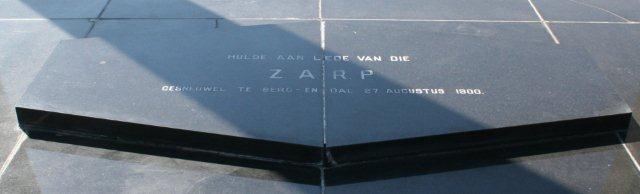
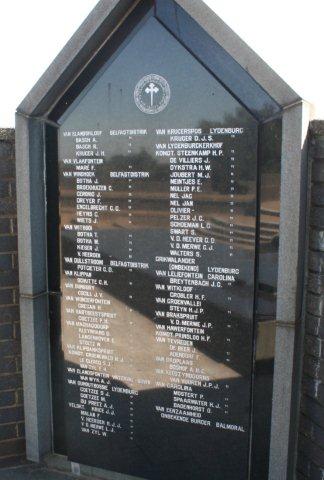


Photos taken May 2012.
Coordinates: S25°44’5.25″ E30° 6’11.19″
References:
“Veldslae uit die Anglo-Boere Oorlog”, by Elria Wesssels
Photos:
Boere Republieke, photo collection (www.boererepublieke.co.za)